 Economiks
Ernest Akinlola: How does underutilized human potential affect the economy?
April 27, 2026Ernest Akinlola on unlocking human potential, its impact on economies, and breaking free from limitations through practical, real-world insights.

 Martina Veselinović
What does happiness mean to you?
When was the last time you truly felt happy?
Is happiness the ultimate goal we all strive for?
What affects happiness?
How do we attain, nurture, and sustain happiness in our daily lives?
Can we truly experience happiness every day?
Throughout history, the world has gone through various socio-economic systems—primitive communal societies, slavery, feudalism, communism, socialism, and capitalism. Which of these systems has brought the most prosperity and happiness to people?
Do you believe that past systems failed for a reason, or could some historical economic systems have provided more happiness and stability than today’s capitalism?
How do we measure happiness? Is happiness determined by the size of your bank account or by inner peace and emotional well-being? Does sharing happiness with others amplify it? Can a country’s economic growth and prosperity directly contribute to the happiness of its citizens?
Psychologists argue that our thoughts shape our emotions, and our emotions ultimately define our feelings—suggesting that happiness is, in many ways, a product of our mindset. This means that those who feel unhappy might benefit from working on their emotional intelligence and the clarity of their thoughts.
Religious teachings have long explored the nature of happiness. In the Bible of Orthodox Christianity, it is written, “The kingdom of God is within you,” implying that happiness comes from within. By achieving self-awareness and shifting our perspective on life, we can experience true inner peace and harmony.
In the end, happiness may not be a final destination, but a journey we build through our thoughts, actions, and relationships with others. It is both a personal and a social dimension – something we carry within ourselves, yet also create within our communities. Perhaps it cannot truly be measured in numbers, but in the sense of meaning, belonging, and inner freedom.
Continue reading to discover whether happiness can indeed be measured, and how we can actively work to enhance it – both in our own lives and in society.

In economic practice, there is an indicator specifically designed to measure happiness. The first country in the world to introduce the Gross National Happiness (GNH) index was the Kingdom of Bhutan in 1972, emphasizing that happiness has measurable value. Even then, it was recognized that Gross Domestic Product (GDP)— which represents the total value of goods and services produced within a national economy — was not a sufficient indicator of a country’s success.
It is important to distinguish GDP from Gross National Product (GNP), which measures the total value of goods and services produced by a nation’s residents, both domestically and abroad.
The Kingdom of Bhutan pioneered the idea that the following components of Gross National Happiness are more significant indicators of a country’s wealth than mere income:
These factors highlight that true prosperity goes beyond financial gains. After all, what is the value of wealth if the soul remains empty and unfulfilled? But this raises an important question: Should modern economies redefine success by prioritizing well-being over material wealth?
Prominent economists, such as Richard Layard, have extensively studied the relationship between income and happiness. Their research indicates that while an increase in a country’s average salary contributes to higher levels of happiness, this effect diminishes once a certain income threshold is reached.
In other words, additional income growth does not lead to a proportional increase in overall life satisfaction. This means that once the majority of the population overcomes extreme poverty and secures basic necessities such as access to food, education, and healthcare, further income growth has a limited impact on their overall happiness.
Studies have shown that Western economies are becoming wealthier, yet their citizens are increasingly unhappy. Financial security alone is not the sole factor that shapes a person’s happiness.
Renowned economist Richard Layard identifies seven key factors that influence happiness:
On the other hand, high divorce rates, unemployment levels, and the quality of government governance are among the most significant contributors to public dissatisfaction.
In 2012, the United Nations, at the initiative of the Kingdom of Bhutan, introduced the Global Happiness Report, which is published every year on March 20th, the International Day of Happiness.
This report ranks 147 countries based on the subjective assessments of respondents regarding the following factors:
And other factors identified as influencing happiness:
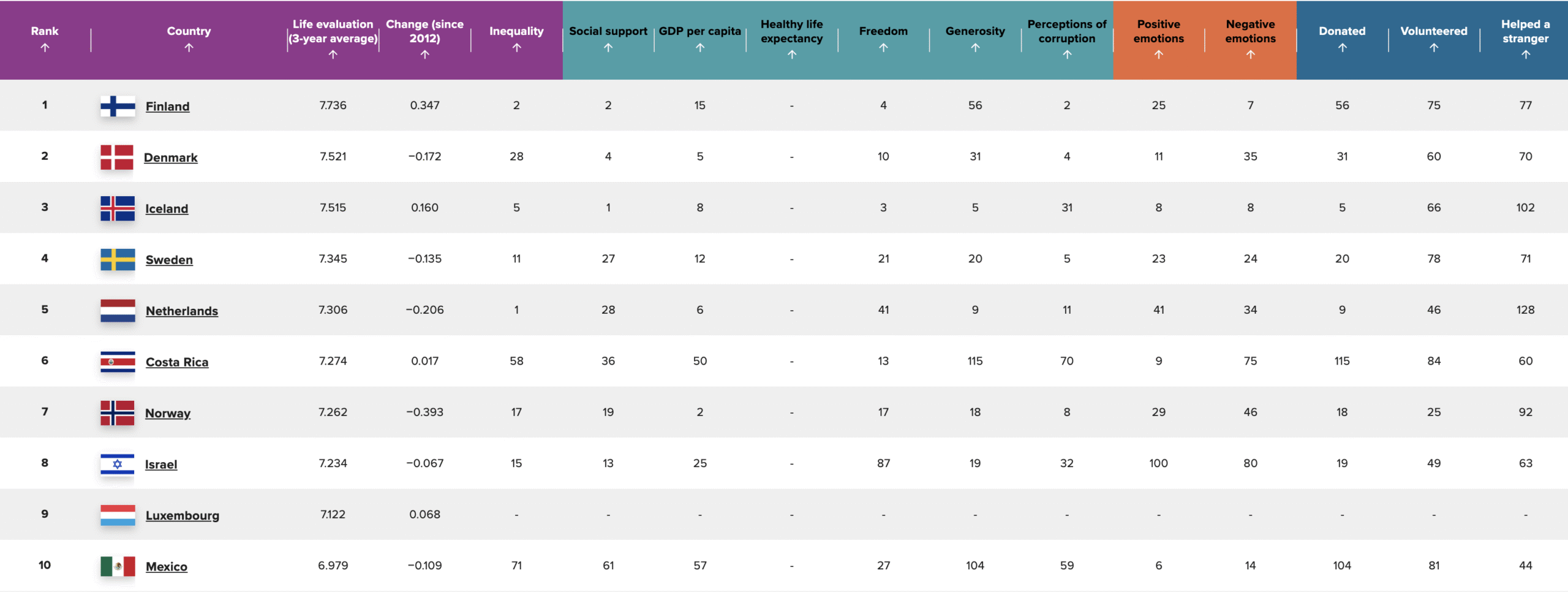
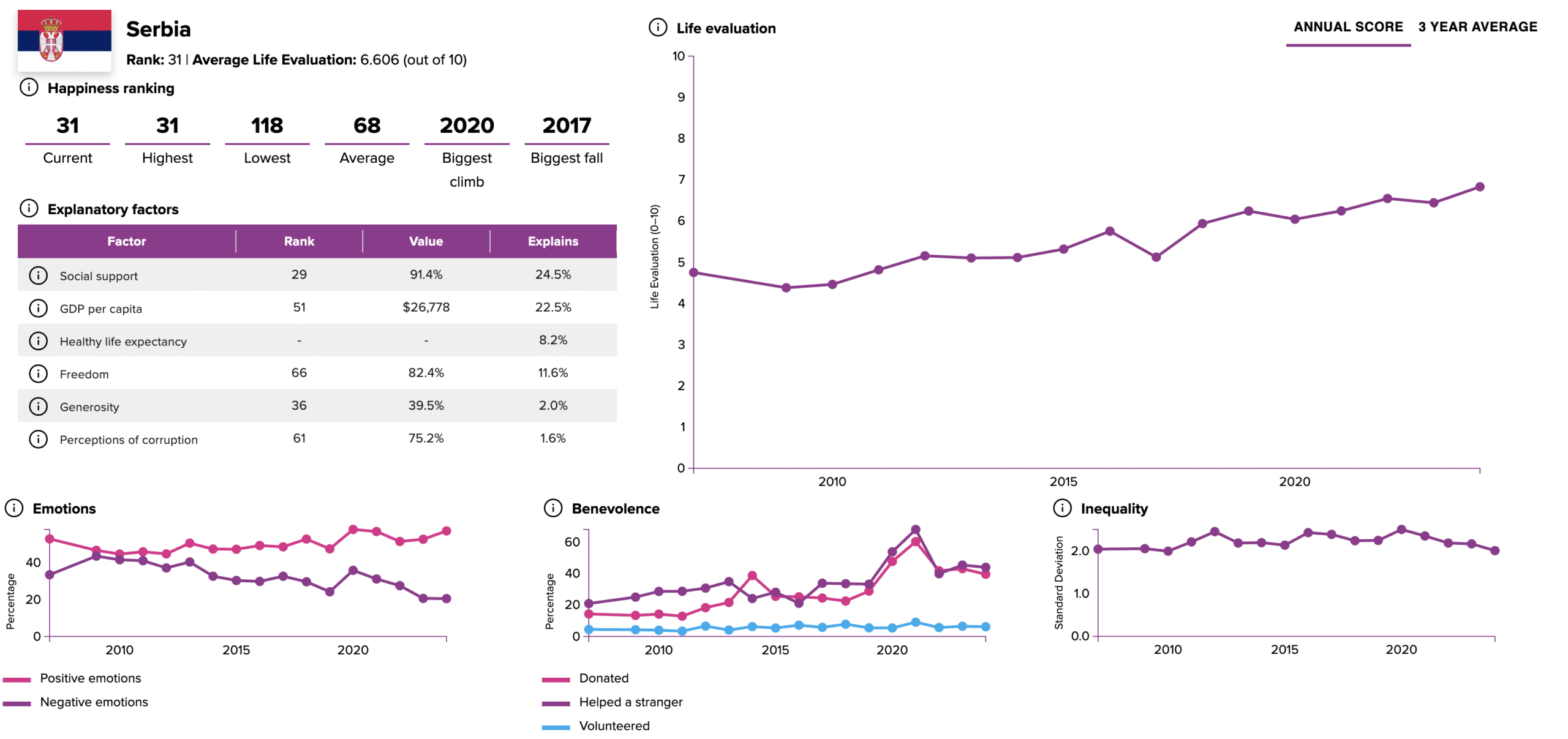
What is interesting is that the Kingdom of Bhutan does not appear on this list, and its ranking in terms of happiness is not mentioned. Additionally, it is quite interesting that self-proclaimed state Kosovo ranks 29th, considering it still faces serious challenges such as high unemployment, underdeveloped infrastructure, political instability, widespread corruption, and limited access to quality public services like education and healthcare.
From personal experience, after six months of living in Norway – a country ranked among the top 10 happiest countries in the world – I gained the impression that the high level of trust in the community is a result of effective governance. Norway is characterized by exceptional infrastructure, organized public transport, and strong government support through social programs, healthcare, education, and the social security system. These factors contribute to achieving a high level of well-being and social justice, often earning the country recognition as an example of a perfect society.
On the other hand, although Norway regularly ranks high in global happiness indexes, certain challenges remain overlooked in these rankings. Social inclusion and mental health issues, including the suicide rate, are negative factors that highlight the need for further attention.
In 2016, the United Arab Emirates established the Ministry of Happiness and Wellbeing with the goal of enhancing the quality of life of its citizens. The ministry focuses on promoting positive thinking, creating policies that support the wellbeing of the population, and building a society based on satisfaction, balance, and productivity. Through various initiatives – from mental health programs to employee support in both the public and private sectors – the UAE sends a clear message that economic development must go hand in hand with the happiness and wellbeing of its people.
If we consider the empirical facts that a person’s happiness depends on many factors, not just earned money and the economic progress of a country measured by GDP, governments should create an environment where the individual is at the center of attention – where their emotional, social, and spiritual well-being is equally valued as economic development. This should include supporting policies that promote the quality of life and the environment, mental health, education, and mutual connections within the community. By integrating these elements into development strategies, society can achieve more sustainable and comprehensive progress in terms of overall satisfaction and quality of life.
Countries should introduce mandatory practices like the Kingdom of Bhutan & UAE and incorporate happiness indicators as one of the fundamental measures of a country’s success and national prosperity. In this way, perhaps the capitalist system could be replaced by a new one where the size of one’s wallet is no longer a reflection of an individual’s power, success, and strength.
Reproduction of content is permitted only with clear attribution and a direct link to the original article.